
Some people are remembered for their ideas. Others for their achievements. And then there are those remembered for a single, unforgettable feature. Thomas Wedders belongs firmly in that last category. Living in 18th-century Yorkshire, England, Wedders became a historical curiosity not because of what he built or wrote—but because of what he carried on his face.
His nose, reportedly measuring an astonishing 7.5 inches, earned him a record that still stands today. Even centuries later, his story continues to spark fascination, disbelief, and endless curiosity. So who was Thomas Wedders really? And why does his story still matter?
Let’s unpack it.
Video: That’s one sizable snooter! 👃 Thomas Wedders, or Wadhouse, had the largest nose of all time! We don’t know exactly how long his nose was
A Man Who Couldn’t Blend Into the Crowd
Born around 1730 in Yorkshire, Thomas Wedders—sometimes referred to as Thomas Wadhouse—stood out the moment he entered a room. His nose was not just large; it was extraordinary by any standard, even today.
In an era without social media or instant photography, word traveled fast. People talked. Writers joked. Illustrators exaggerated. His appearance made him impossible to ignore in a time when conformity was the norm.

If history were a stage, Wedders didn’t choose the spotlight—it followed him.
Accidental Fame in an Age of Curiosity
A Curious Celebrity of His Time
The 18th century was obsessed with the unusual. Public exhibitions featuring physical anomalies were common, and Wedders is believed to have appeared in such shows. Whether by choice or circumstance, his nose became his calling card.
Newspapers and magazines mentioned him with a mix of humor and disbelief. One publication famously joked that if importance were measured by nose size, Wedders could have ruled Europe. That line alone tells you everything about how society viewed him: part amusement, part awe.
Video: Thomas Wedders, The Man With The Longest Nose in History
He was talked about, written about, and remembered—yet rarely understood.
Fame Without a Voice
What makes Wedders’ story so haunting is how little we hear from him directly. There are no diaries. No letters. No personal reflections. We only know him through the lens of observers, many of whom treated him more as a novelty than a person.
That silence leaves a lot of room for questions.
A Life Wrapped in Mystery
Despite his notoriety, Thomas Wedders remains largely unknown as a human being. We don’t know how he felt about his appearance. Did he accept it? Resent it? Use it to survive in a harsh world?
Records fail to tell us whether he chose to appear in exhibitions or was pushed into them by necessity. There’s no clear evidence of his family life, relationships, or inner world.
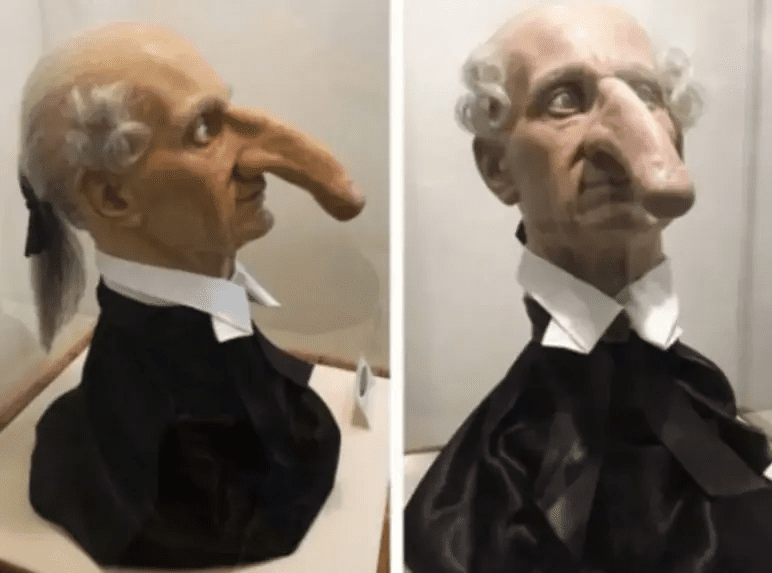
He reportedly died in his 50s around 1780, leaving behind little more than stories, satirical remarks, and later, wax replicas displayed in curiosity collections.
Video:
Life with the longest nose – Guinness World Records
In a strange way, his absence of detail makes his presence even stronger.
The Science Behind the Nose
What Caused Such an Extreme Feature?
To this day, no definitive explanation exists for Wedders’ extraordinary nose. Some researchers speculate that he may have had a rare genetic condition or an untreated medical disorder that caused excessive tissue growth.
Others suggest the possibility of rhinophyma or other connective tissue anomalies, though no medical records survive to confirm this. There are even rumors—likely exaggerated—that unusual family circumstances contributed to his appearance.

The truth is, we may never know. And that uncertainty keeps the mystery alive.
From History Books to Internet Virality
A Story That Refused to Stay Buried
Fast forward to the modern era, and Thomas Wedders found a second wave of fame—this time online. Images of wax figures believed to represent him resurfaced on platforms like Reddit, where users reacted with shock, humor, and pop-culture comparisons.
Some likened him to cartoon characters. Others compared his nose to animals known for elongated snouts. The reactions were lighthearted, but they also highlighted something deeper: our ongoing fascination with the extraordinary.
Even in a world saturated with visuals, Wedders still stands out.
Historical Records vs. Modern Measurements
A Record That Still Stands
According to Guinness World Records, Thomas Wedders remains the historical record holder for the longest nose ever documented. His reported 7.5-inch nose has never been surpassed.
In modern times, the title belongs to Mehmet Özyürek from Turkey, whose nose measures approximately 3.46 inches. While impressive, it’s still less than half of Wedders’ legendary measurement.

That comparison alone shows just how extreme Wedders’ case was—and why he continues to be referenced centuries later.
Why Thomas Wedders Still Matters
At first glance, his story might seem like a footnote in history. A man with a big nose. A strange curiosity. But look closer, and something deeper emerges.
Wedders represents how society treats those who look different. He lived in a time without modern medicine, disability rights, or empathy-driven narratives. His fame came with humor, not understanding.
Yet here we are, still talking about him.
His story reminds us that history isn’t only shaped by kings and inventors. Sometimes, it’s shaped by people who never asked to be remembered—but were impossible to forget.
Thomas Wedders lived a life defined by a single, extraordinary feature. His 7.5-inch nose made him famous, mysterious, and unforgettable. Though much of his personal story has been lost to time, his legacy remains a powerful reminder of humanity’s endless fascination with the unusual.
From 18th-century Yorkshire to modern internet culture, Wedders continues to capture attention—not because of who he was allowed to be, but because of what he represented. In the end, his story isn’t just about a nose. It’s about curiosity, difference, and the thin line between wonder and spectacle.